
Tin-lead solder 60/40, 63/37 and 50/50: wire, bars and sticks
Sn60Pb40, Sn63Pb37, Sn62Pb36Ag2 and 50/50 to EN ISO 9453, direct from the manufacturer
Tin-lead alloys remain the technical choice wherever lead is permitted: equipment outside the scope of RoHS, applications covered by exemptions, spare parts, electrical engineering, sheet-metal work. They melt at lower temperatures than lead-free alloys, wet better and are more forgiving in hand soldering. Dickmann manufactures them as flux-cored wire, solid wire, bars and sticks. To find out when they can be used, see the guide to RoHS exemptions for lead.
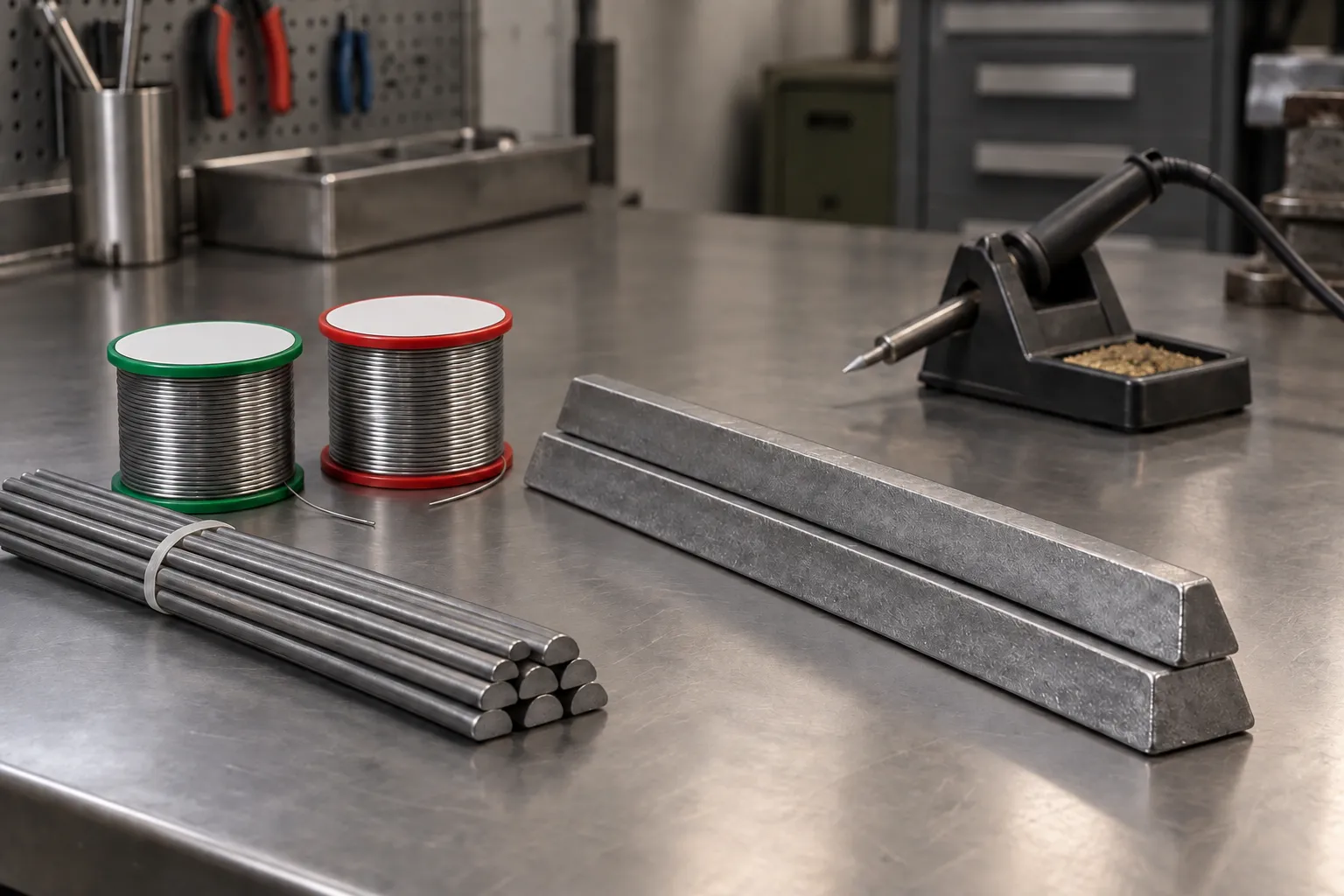
Tin-lead alloys in our range
The first number is the tin percentage: a 60/40 contains 60 % tin and 40 % lead. All of them start to melt at around 183 °C; the more lead the alloy contains, the higher the liquidus and the wider the pasty range.
| Alloy | Melting | Formats | Typical use |
|---|---|---|---|
| Sn63Pb37 | 183 °C (eutectic) | Flux-cored wire, bars | Permitted or exempt electronics, rework, fast soldering with no pasty phase |
| Sn62Pb36Ag2 | approx. 179 °C | Bars, flux-cored wire, paste | Components with silver-plated terminations, precision electronics |
| Sn60Pb40 | 183–190 °C | Flux-cored wire, solid wire, bars, sticks | The most widely used tin-lead alloy: electronics, wiring, tinning |
| Sn60Pb39Cu1 | approx. 183–190 °C | Flux-cored wire | Hand soldering: copper reduces tip wear |
| Sn50Pb50 / Sn50Pb49Cu1 | 183–216 °C | Flux-cored wire, solid wire, sticks | Electrical engineering, roofing sheet-metal work and zinc |
| Sn40Pb60 | 183–235 °C | Flux-cored wire | Large joints, low-cost tinning |
Typical temperatures. Alloys manufactured to EN ISO 9453:2020 with metals of purity above 99.9 %; certificate of analysis for each lot.
How to choose the alloy
To choose the flux for flux-cored wire, see the guide to IPC J-STD-004 classification and the one on how to choose flux-cored wire.
- Sn63Pb37 for electronics: being eutectic, it goes from liquid to solid with no pasty phase, reduces cold joints caused by movement during cooling and is suited to fine-pitch components.
- Sn60Pb40 for general use: hand soldering of boards and wiring, tinning of conductors, wave solder baths where lead is permitted.
- Sn62Pb36Ag2 when components have silver or palladium-silver terminations, to limit their dissolution.
- Sn60Pb39Cu1 for those who do a lot of hand soldering and want to extend tip life.
- Sn50Pb50 and Sn40Pb60 for large joints, electrical engineering and sheet metal, where a wide pasty range is needed to shape the bead.
Available formats
- Flux-cored wire with rosin fluxes Alfa C and Alfa E (ROL0), Impetol B (ROM1) for difficult surfaces, Dixtra Gel and Dixtra Glico for structural soldering on copper, brass and iron.
- Solid wire without flux, on request, for tinning, robots and solder pot top-up.
- Dixtra Electronic bars in Sn63Pb37, Sn62Pb36Ag2 and Sn60Pb40, on request, for wave solder baths, dip tinning and HASL.
- 50/50 and 60/40 solder sticks with half-round section for sheet-metal work, zinc coffins and torch soldering.
- AIM M8 no-clean solder paste also in leaded alloy, for SMT assembly where lead is permitted.
When they can be used
The RoHS directive limits lead to 0.1 % by weight in the homogeneous materials of electrical and electronic equipment. Tin-lead alloys can therefore still be used in products outside the scope of the directive, in applications covered by exemptions in force and in many non-electronic uses, such as sheet-metal work, zinc coffins and lead-acid batteries. Verification is the responsibility of the equipment manufacturer: see the guide to RoHS exemptions and the table of melting temperatures.
Tin-lead baths: same composition, same process
For bars and solid wire only the chemical composition matters: with the same alloy, the process and the finished products do not change. If you run a tin-lead bath from another supplier, you can top it up with Dickmann bars of the same alloy. With our solder bath analysis we check copper, iron and impurities and track the composition over time.
- Keep solder pots, tools and stock of leaded alloys separate from lead-free ones.
- Never top up a lead-free bath with leaded alloys, or vice versa.
- Label solder pots with the alloy in use.
Safe handling
- Read the safety data sheet of each alloy and flux before use.
- Extract soldering fumes at the source: they come mainly from the flux.
- Do not eat, drink or smoke in the work area, and wash your hands after handling leaded alloys.
- Collect dross, residues and spent alloy separately: they can be sent for recovery.
Frequently asked questions about tin-lead alloys
Request a quote for tin-lead alloys
Tell us the alloy, format and annual quantity