SAC0307 and SAC0307 with bismuth: the low-silver alloy for wave and selective soldering
Sn99Ag0.3Cu0.7, also with 0.1 % bismuth, direct from the manufacturer: bars, solid wire and flux-cored wire for wave and selective soldering
SAC0307 is a lead-free solder alloy with 0.3 % silver and 0.7 % copper: it costs less than SAC305 because it contains one tenth of the silver. On wave soldering lines it is often used in the version with about 0.1 % bismuth, which improves wetting and joint strength after thermal ageing. Dickmann produces both versions and sells them directly, with no distribution steps in between. Ideal for electronics, automotive and industrial applications. Discover also our other lead-free alloys.
Why choose the SAC0307 alloy
What you gain and what you lose compared with SAC305
SAC0307 alloy technical data
Properties of the Sn99/Ag0.3/Cu0.7 alloy
| Property | Value | Unit | Notes |
|---|---|---|---|
| Composition | Sn99/Ag0.3/Cu0.7 | % | 0.3 % silver, 0.7 % copper, balance tin; version with 0.1 % bismuth |
| Solidus | 217 | °C | Start of melting |
| Liquidus | 227 | °C | Fully molten, about 7 °C above the SAC305 liquidus |
| Density | 7.3 | g/cm³ | Typical value at room temperature |
| Standards | EN ISO 9453:2020 no. 501, IPC J-STD-006 | - | Bismuth version: composition to specification derived from alloy EN ISO 9453 no. 501 |
| Compliance | RoHS, REACH | - | Lead-free alloy |
Direct from the manufacturer, not from a distributor
Dickmann produces its own alloys in its own plant in Italy: SAC0307 bars, solid wire and flux-cored wire come directly from our plant, without the chain of distributors and resellers that separates customers from the large international brands. For small and medium-sized companies this means a more competitive price for the same alloy, even small lots (minimum order one 25 kg box for bars) and direct contact with the people who produce and analyse the alloy.
For bars and solid wire, which contain no flux, soldering behaviour is determined solely by the chemical composition of the alloy and its freedom from oxides. With the same composition, the process and the finished products do not change: that is why every lot comes with a spectrometric analysis certificate (spark OES) stating the content of tin, silver, copper, bismuth and impurities.
- Manufacturer's price, with no distribution mark-ups.
- Composition certified for every lot by spectrometric analysis.
- Same nominal composition as the most common SAC0307 with bismuth alloys: no process change for bars and solid wire.
- Bath monitoring over time with periodic analyses.
SAC0307 with bismuth: what it is and why EMS providers use it
Basic SAC0307 contains only tin, silver and copper. Many electronics manufacturers in Italy, however, run their wave soldering lines with SAC0307 doped with about 0.1 % bismuth: the nominal composition Sn-0.3Ag-0.7Cu-0.1Bi, which has become a de facto standard on low-silver wave soldering lines.
In such small amounts, bismuth does not change the melting range but improves the wetting and spreading of the alloy. In high-speed ball pull tests on joints aged for 500 hours at 150 °C, adding 0.1 % bismuth to SAC0307 markedly reduced brittle fractures. In our market experience, this is why the bismuth version has spread in wave and selective solder pots in place of SAC305.
| Version | Nominal composition | Melting | Typical use |
|---|---|---|---|
| SAC0307 | Sn 99 / Ag 0.3 / Cu 0.7 | 217–227 °C | Wave, selective, HASL, solid wire |
| SAC0307 with bismuth | Sn balance / Ag 0.3 / Cu 0.7 / Bi 0.1 | 217–227 °C | EMS wave and selective soldering, rework, lead tinning |
| Sn99.7Ag0.3 | Sn 99.7 / Ag 0.3, copper-free | See technical data sheet | Top-up to lower copper in SAC0307 baths |
Nominal values. The bismuth version is a composition to specification derived from alloy EN ISO 9453 no. 501, which allows a maximum of 0.06 % bismuth. The bismuth content can be adjusted to customer specification: state it in your quote request.
Switching supplier without changing the process
If your bath is already SAC0307 with bismuth from another supplier, you can top it up with Dickmann bars of the same nominal composition, without emptying the solder pot and without changing the machine parameters. Before switching, send us a sample of at least 250 grams from the bath: with our bath analysis we check silver, copper, bismuth and impurities and recommend the most suitable top-up alloy. We can then monitor the composition of the bath over time with ongoing analyses, at intervals agreed according to your volumes.
- Send a sample of the bath in use and the specification of the alloy you are using.
- Receive the analysis report with the measured composition.
- Top up with SAC0307 with bismuth bars and send us a sample at regular intervals: we alert you in advance when copper or impurities approach the limits.
Typical wave soldering parameters
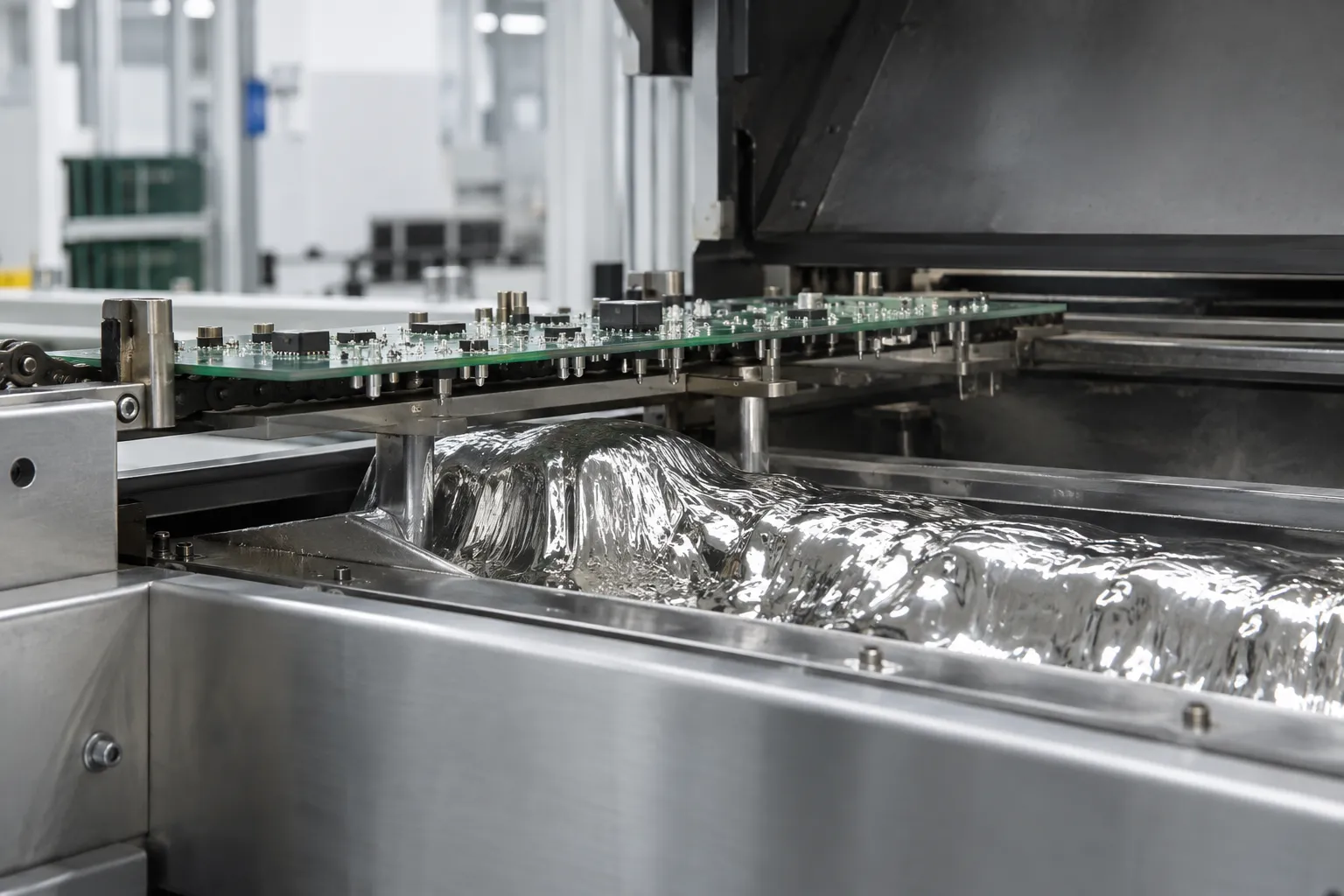
With the liquidus at 227 °C, the bath typically runs between 255 and 265 °C, with contact times of about 2–3.5 seconds depending on single or dual wave configuration. Copper in the bath should be kept between 0.7 and 1 %: above 1 % the liquidus rises and bridges and icicles increase. To bring it back within limits, top up with our copper-free Sn99.7Ag0.3 alloy, which lowers copper while keeping silver at 0.3 %. See the guide to copper erosion and bath contamination and the one on dross in wave soldering.
Available formats
- Dixtra Electronic bars of about 1 kg for wave and selective solder pots, in 25 kg boxes (minimum order one box).
- Solid wire from 0.5 to 4 mm on spools from 0.25 to 4 kg for automatic top-up of selective soldering machines.
- Flux-cored wire for hand soldering, rework and soldering robots.
- Copper-free Sn99.7Ag0.3 bars for topping up baths.
- SAC0307 in both versions, with and without bismuth, with an analysis certificate for every lot.
Where the SAC0307 alloy is used
Bath processes and production where the cost of the alloy matters


SAC0307 compared with SAC305, SAC405 and Sn-Cu
Composition, melting and typical use of the main lead-free alloys
| Alloy | Composition | Melting Point | Application Notes |
|---|---|---|---|
| SAC0307 | Sn99/Ag0.3/Cu0.7 | 217–227 °C | Low silver, contained cost: wave, selective, HASL |
| SAC0307 with bismuth | Sn/Ag0.3/Cu0.7/Bi0.1 | 217–227 °C | The bismuth-doped version used on the wave soldering lines of EMS providers |
| SAC305 | Sn96.5/Ag3/Cu0.5 | 217–220 °C | The electronics standard: SMT reflow and specifications that require it |
| SAC405 | Sn95.5/Ag4/Cu0.5 | 217–219 °C | More silver, for high-reliability specifications; higher cost |
| Sn-Cu | Sn99.3/Cu0.7 | 227 °C | Silver-free, eutectic, the most economical |
💡 Nota: SAC0307 sits between Sn99.3Cu0.7 and SAC305: the small amount of silver improves wetting compared with the silver-free alloy, at a much lower cost than SAC305.
Frequently asked questions about the SAC0307 alloy
Answers from Dickmann technicians
Request a quote for the SAC0307 alloy
Bars, solid wire and flux-cored wire · Direct from the manufacturer
Compare SAC0307 with the SAC305 alloy, the Sn99.3Cu0.7 tin-copper alloy and the silver-free 99SnCuNiGe alloy (SN100C equivalent), or read the guide to selective soldering. Complete overview of lead-free alloys.
Telefono
+39 02 6604 7053