
Solder Alloys for Electrical Soldering and Tinning
Alloys for soldering and tinning cables, cable lugs, copper braids and windings
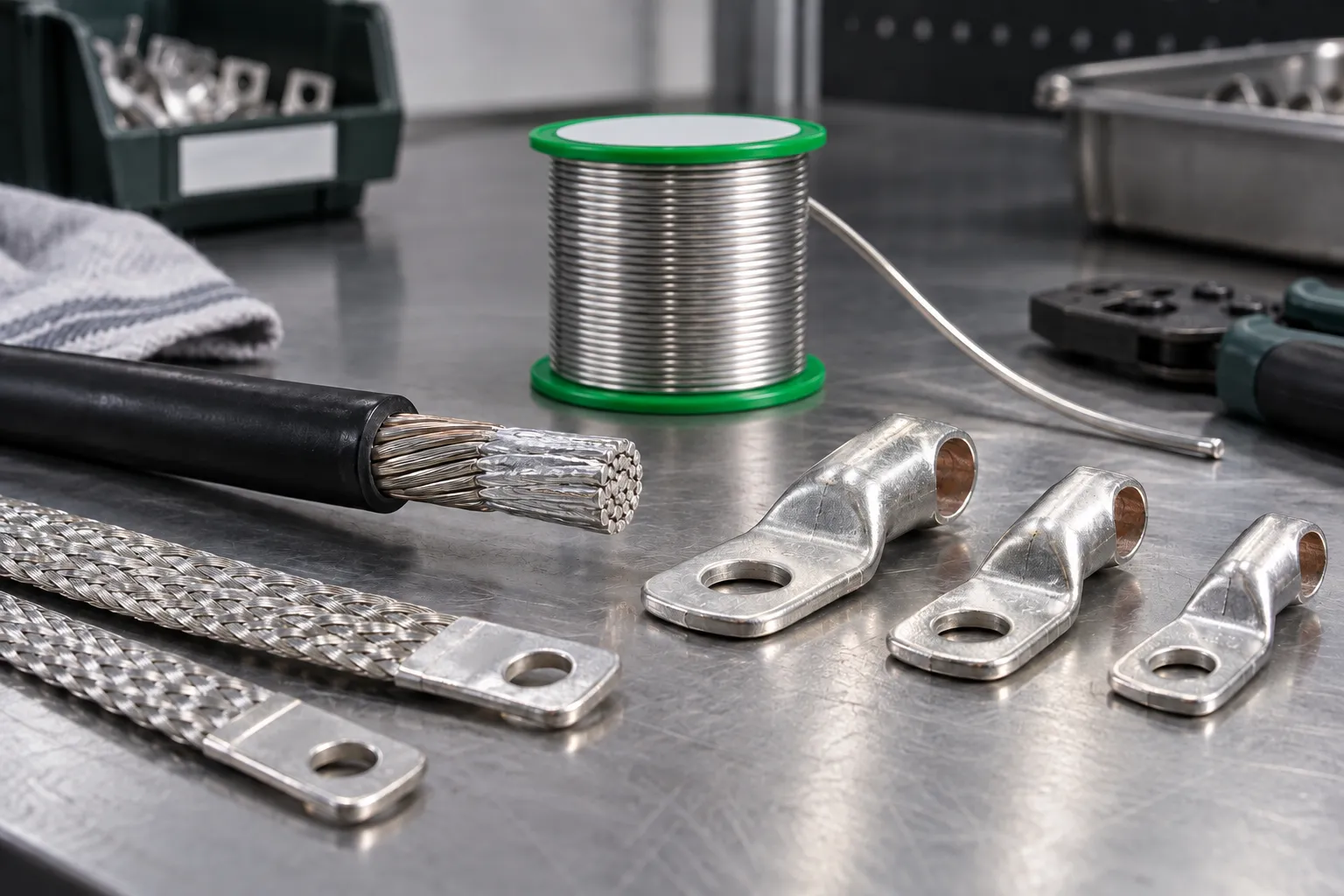
Alloys for soldering and tinning cables, cable lugs and braids: Sn99.3Cu0.7 tin-copper alloy, SAC305 and Sn60Pb40 where permitted. For battery terminals see the battery grade alloys, for electrolytic tinning the pure tin anodes.
Why Choose Our Alloys for Electrical Engineering
Optimal electrical and mechanical performance
Recommended Alloys for Electrical Engineering
Technical characteristics for electrical applications
| Alloy | Composition | Melting | Application |
|---|---|---|---|
| Sn60Pb40 | Sn60/Pb40 | 183–190 °C | Traditional tinning, where lead is permitted |
| SAC305 | Sn96.5/Ag3/Cu0.5 | 217–220 °C | Lead-free, wiring and power electronics |
| Sn99.3Cu0.7 | Sn99.3/Cu0.7 | 227 °C | Economical lead-free, tinning of conductors and braids |
| Sn96.5Ag3.5 | Sn96.5/Ag3.5 | 221 °C | Eutectic, bright joints |
Tinning of terminals, braids and conductors
In electrical engineering the alloy is often used more for tinning than for soldering: terminals, copper braids and conductor ends are dipped in a bath of molten alloy or tinned with the soldering iron, to protect them from oxidation and prepare them for soldering. The ends of flexible conductors intended for screw terminals must not be tinned (IEC 60364-5-52): there, cable lugs or ferrules are used.
Tinning baths use bars of Sn99.3Cu0.7 or, where permitted, Sn60Pb40 and Sn63Pb37; for continuous top-up, solid wire. Oxidised conductors need a more active flux, such as Impetol B (ROM1) flux-cored wires or organic fluxes, with cleaning of the residues. Flux does not remove the enamel from enamelled wires: solderable enamels are stripped in the high-temperature bath, the others must be removed mechanically.
Lead or lead-free?
The RoHS directive restricts lead in electrical and electronic equipment. Large-scale stationary industrial tools and large-scale fixed installations, for example, are outside its scope; there are also exemptions for specific uses and rules for spare parts of equipment placed on the market before the bans. Where none of these applies, lead-free alloys such as Sn99.3Cu0.7 or SAC305 are required.
| Use | Lead-free alloys | Leaded alloys (if permitted) |
|---|---|---|
| Wiring and connectors | SAC305, Sn99.3Cu0.7 | Sn60Pb40, Sn63Pb37 |
| Tinning baths | Sn99.3Cu0.7 | Sn60Pb40, Sn63Pb37 |
| Motors and transformers | Sn99.3Cu0.7, SAC305 | Sn60Pb40 |
Flux-cored wire or solid wire?
For hand soldering of cables and cable lugs, flux-cored wires from 0.5 to 3 mm; for larger diameters and for baths, solid wire up to 4 mm with separate flux is used. For batteries see the battery grade alloys, for electrolytic tinning the tin anodes.
Electrical Soldering Applications
Typical sectors and installations
Electrical Control Panels
LV wiring, busbar connections, terminals and cable lugs on copper conductors.
Industrial Plants
Power distribution, motor connections, transformers. High-current copper joints, mechanical strength.
Lighting
LED drivers, power supplies, lamp connections. Soldering of power components, heat dissipation.
Renewable Energy
Photovoltaic inverters, string box connections, LV panels. High reliability, resistance to UV and temperature.
Soldering vs Crimping in Electrical Engineering
When to choose soldering for electrical connections
| Aspect | Soldering | Crimping | Notes |
|---|---|---|---|
| Conductivity | Excellent (continuous) | Good (contact) | Soldering: continuous path |
| Mechanical Strength | High | Very high | Crimp: higher tensile strength |
| Installation Time | Medium | Fast | Crimping is faster |
| Reliability | High, if the joint is not subject to vibration | High with a calibrated tool | Both depend on workmanship |
| Cost | Low (material) | Medium (tools) | Crimping: initial investment |
Recommendation: soldering for permanent high-reliability connections (fixed panels, industrial plants). Crimping for fast installations, field wiring, frequent maintenance. Do not combine the two methods: a crimped terminal must not be soldered and a tinned conductor must not be crimped.
Frequently Asked Questions about Electrical Soldering
Everything you need to know about soldering for electrical installations
Request Advice for Electrical Engineering Applications
Compare the lead-free alloys, choose the flux and find out about our ISO 9001 quality system. Request a quotation for formats and quantities.
Telefono
+39 02 6604 7053