
Selective Soldering Alloys, Bars and Solid Wire: Solder Bath Management
Bars for the solder pot and solid wire for top-up, in the lead-free alloys most used in selective soldering
Bars and solid wire for selective soldering machine pots, in the alloys 99SnCuNiGe (SN100C equivalent), low-silver SAC0307 and SAC305. For automatic top-up see the 0.5 to 4 mm solid wire, for the board the spray no-clean fluxes.
Why Choose Our Alloys for Selective Soldering
Optimised performance for automated processes
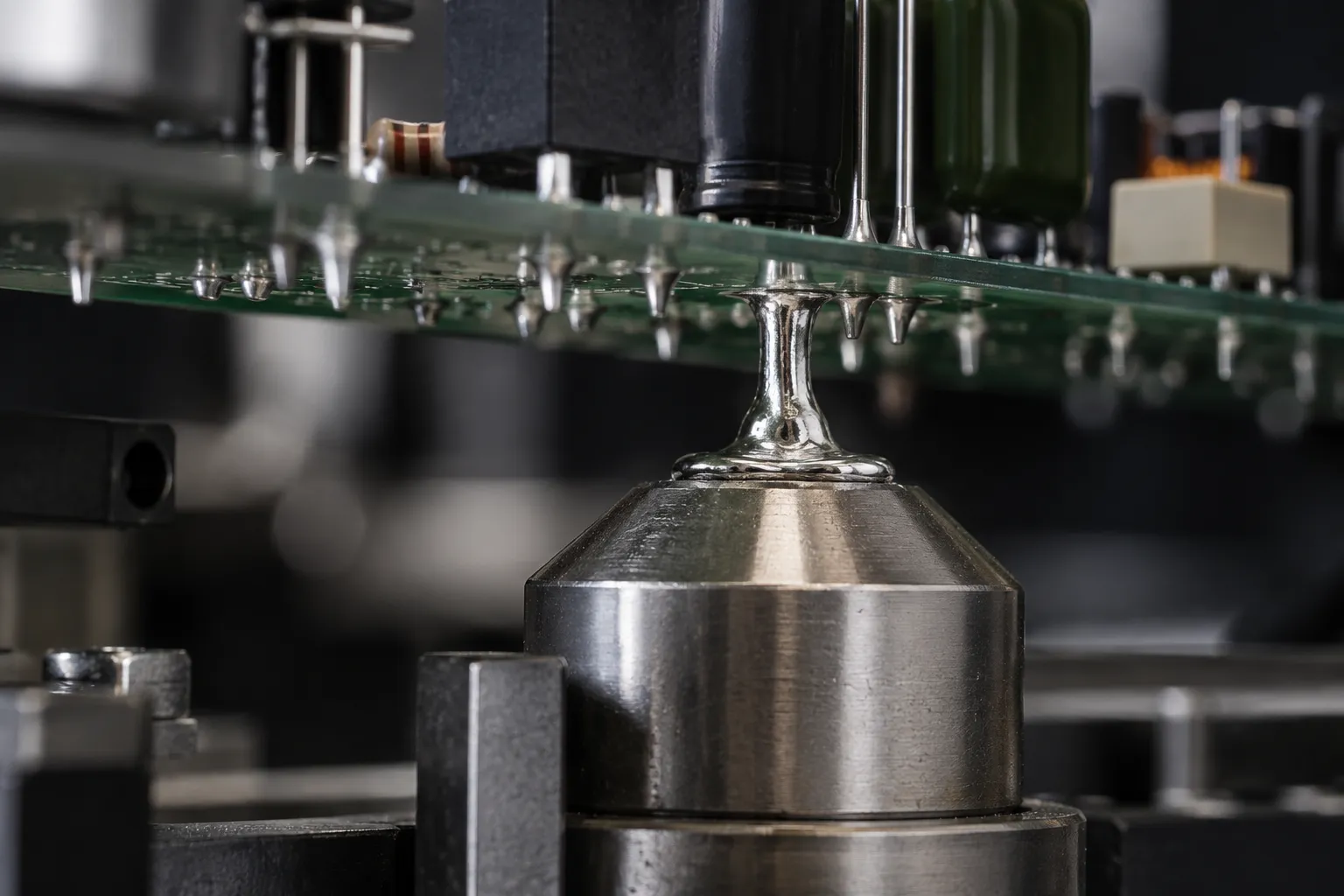
Recommended Alloys for Selective Soldering
Lead-free alloys for selective soldering machine pots
| Alloy | Composition | Melting Point | Application |
|---|---|---|---|
| 99SnCuNiGe (SN100C equiv.) | Sn/Cu0.7/Ni0.05/Ge | 227 °C | Silver-free, less dross and copper dissolution |
| SAC0307 | Sn99/Ag0.3/Cu0.7 | 217–227 °C | Low silver, contained cost |
| SAC305 | Sn96.5/Ag3/Cu0.5 | 217–220 °C | When the specification requires SAC305 |
| Sn99.3Cu0.7 | Sn99.3/Cu0.7 | 227 °C | Silver-free, the most economical |
Solder bath management in selective soldering
In selective soldering machines the alloy works in a small solder pot, with nozzles that deliver it only to the points to be soldered. The bath is therefore more exposed to variations in temperature and composition than a traditional wave: keeping it under control is the condition for repeatable joints.
With lead-free alloys the solder pot temperature is typically between 280 and 320 °C, depending on the nozzle and the thermal mass of the board: higher than in wave soldering, because the small volume of alloy in the nozzle has to heat joints that may have a large thermal mass. The exact value also depends on the alloy and on the machine manufacturer's instructions.
During production the bath dissolves copper from pads and leads. Above certain levels, copper raises the liquidus, worsens fluidity and promotes bridging and icicles. Alloys with nickel and germanium, such as 99SnCuNiGe, limit copper dissolution and dross formation. Nitrogen around the nozzle further reduces oxidation.
- Top up with the same alloy family as the bath: bars for filling, solid wire for continuous top-up; when copper is high, the copper-free version (Sn99.7Ag0.3 for SAC0307, 99SnNiGe for 99SnCuNiGe).
- Regularly remove the dross from the surface of the solder pot.
- Have the bath analysed periodically: dissolved copper and iron show when to dilute or replace the alloy.
- Do not mix different alloys: between compatible lead-free alloys you can change over by gradual dilution, verified by analysis; from tin-lead to lead-free the solder pot must be completely emptied, cleaned, flushed with pure tin and the bath analysed for lead and iron.
Bars or solid wire?
Bars are used for the initial filling of the solder pot and for manual top-ups. Solid wire feeds the solder pot automatically and keeps the bath level constant, avoiding large additions that cool the bath. Dickmann solid wire is available from 0.5 to 4.0 mm on spools from 0.25 to 4 kg: tell us your machine model and we will propose the diameter and spool.
Typical defects and causes
The most frequent defects in selective soldering almost always depend on temperature, flux or bath condition rather than on the alloy.
| Defect | Common causes | What to check |
|---|---|---|
| Bridging between leads | Low temperature, insufficient flux, high copper in the bath | Solder pot temperature, flux dosing, bath analysis |
| Unfilled hole | Insufficient preheating, flux not activated, high thermal mass | Preheating, contact time, nozzle type |
| Solder balls | Excess flux or flux not dried | Amount of flux and drying before soldering |
| Heavy dross | Oxygen, temperature too high | Nitrogen flow, temperature, solder pot cleanliness |
Selective, wave and reflow on mixed-technology boards
On mixed-technology boards, SMT components are reflow soldered first with solder paste, then the through-hole (THT) components by wave or selective soldering. Selective soldering solders only the chosen points and spares the SMT components a pass over the wave. PTH (Plated Through Hole) refers to the plated hole of the circuit board: in Italy many EMS providers call THT assembly “PTH assembly”.
Selective Soldering Applications
Sectors that use the selective process
Automotive Electronics
ECUs, sensors, heavy connectors. THT soldering on PCBs with SMD components already mounted. Mixed SMD+THT process.
Industrial
Industrial controls, inverters, power supplies. THT power components on boards with SMD logic.
Medical
Diagnostic and electromedical instrumentation: THT components on mixed-technology boards, with the alloy defined by the specification.
Telecommunications
Routers, switches, telecom equipment. Connectors, transformers and large THT components on complex PCBs.
Selective vs Wave vs Reflow: Comparison
When to choose selective soldering
| Characteristic | Selective Soldering | Wave Soldering | Reflow |
|---|---|---|---|
| Components | Selected THT only | THT and glued SMD | SMD and THT with pin-in-paste |
| Mixed PCBs | Ideal (SMD+THT) | Yes, with SMD glued on the bottom side | With THT in pin-in-paste |
| Thermal Stress | Minimal (local) | High (entire PCB) | Controlled |
| Flexibility | Maximum | Low | Medium |
| Process Cost | Medium-High | Low | Medium |
Selective soldering is the choice for mixed-technology boards with few THT components (connectors, transformers) or when the wave would put too much stress on the SMT components already soldered.
Frequently Asked Questions about Selective Soldering
Everything you need to know about the selective process
Request Advice on Selective Soldering
See also the solid wire for top-up, the SAC0307 alloy and our ISO 9001 quality system.
Telefono
+39 02 6604 7053