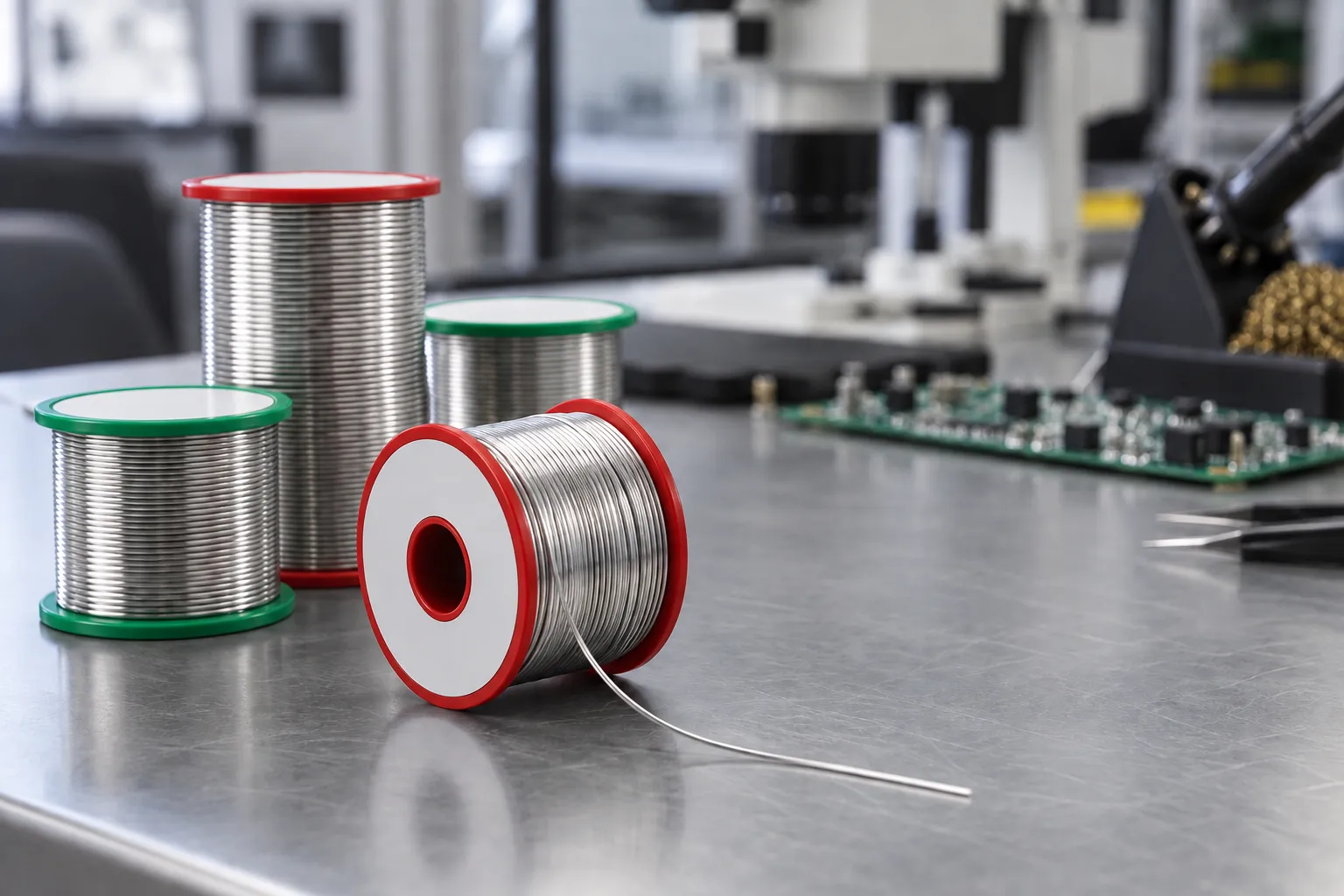
No-clean flux-cored solder wire for manual and robotic soldering
Solder alloy wire with a flux core, from 0.5 to 3 mm, in lead-free and tin-lead alloys
Flux-cored wire contains the flux in its core: alloy and flux melt together, allowing soldering in a single step. Dickmann produces flux-cored wires with rosin, no-clean and water-soluble fluxes, in lead-free and tin-lead alloys, for manual soldering, rework and soldering robots. Our no-clean ROL0 flux-cored wires are ideal for precision electronics, automotive and industrial applications. Discover our SAC305 lead-free alloys and 99SnCuNiGe (SN100C equivalent).
Why Choose Flux-Cored Wires?
Four advantages that make the difference
No-Clean Flux-Cored Wire Technical Specifications
Characteristics of the Dickmann flux-cored wire range
| Specification | Value | Unit | Notes |
|---|---|---|---|
| Diameters | 0.5 – 3 | mm | From precision work to large cross-section conductors |
| Fluxes | No-clean, rosin, water-soluble | - | No-clean and rosin: IPC J-STD-004 ROL0 and ROM1; water-soluble: EN ISO 9454-1 3.1.1.C |
| Standards | IPC J-STD-004, EN ISO 9454-1 | - | Flux classification (EN ISO 9454-1 supersedes DIN EN 29454-1) |
| Alloys | Lead-free and tin-lead | - | See the range table |
The flux-cored wire range
Each flux-cored wire is defined by its combination of flux and alloy. These are the combinations available in the catalogue.
| Product | Flux | Lead-free alloys | Tin-lead alloys |
|---|---|---|---|
| Alfa C | Rosin ROL0, halide-free | SAC0307, 96.5Sn3.5Ag, SAC305, 97Sn3Cu, 99.3Sn0.7Cu, 99SnCuNiGe | 63Sn37Pb, 60Sn39PbCu1, 50Sn49PbCu1, 40Sn60Pb, 63Sn35Pb2Ag |
| Alfa E | Rosin ROL0 | 97Sn3Cu, 99.3Sn0.7Cu, SAC0307, 96.5Sn3.5Ag, SAC305 | 60Sn39PbCu1, 50Sn49PbCu1 |
| Impetol B | Activated rosin ROM1 | 96.5Sn3.5Ag, SAC305, 97Sn3Ag, SAC0307, 97Sn3Cu, 99.3Sn0.7Cu | 60Sn39PbCu1, 40Sn60Pb, 50Sn49PbCu1 |
| Dixtra No Clean | No-clean ROL0 | 99.3Sn0.7Cu, 99SnCuNiGe, SAC305, SAC0307 | — |
| AIM Glowcore | No-clean ROL0 | 99.3Sn0.7Cu, 99SnCuNiGe, SAC305, SAC0307 | — |
| Dixtra Gel | Water-soluble, inorganic salts (EN ISO 9454-1 3.1.1.C) | SAC0307, 96.5Sn3.5Ag, 99.3Sn0.7Cu | 50Sn50Pb, 60Sn40Pb |
| Dixtra Glico | Water-soluble, inorganic salts (EN ISO 9454-1 3.1.1.C), strong activation | SAC0307, 96.5Sn3.5Ag, 99.3Sn0.7Cu | 50Sn50Pb, 60Sn40Pb |
Tin-lead alloys are for uses in which lead is permitted under RoHS exemptions.
How to choose the diameter
The diameter should be chosen according to the pad size and the thermal mass of the joint: a wire that is too thick deposits excess alloy, one that is too thin slows down the work. For automatic topping up of solder pots, flux-free solid wire is used instead.
| Diameter | Typical use |
|---|---|
| 0.5 – 0.8 mm | SMD and small components |
| 0.8 – 1.2 mm | THT components and general use |
| 1.5 – 3 mm | Wiring, connectors and large cross-section conductors |
Tip temperature and flux
With lead-free alloys the soldering iron tip typically works between 330 and 370 °C, with tin-lead alloys lower, around 300–340 °C. The right temperature depends on the tip and the thermal mass: a tip suited to the joint is better than a higher temperature, which degrades the flux and shortens tip life.
The most common versions contain 2 to 3 % flux by weight, in a single core or in multiple micro-cores for more uniform delivery. The percentage and core type of each product are stated in the technical sheet.
The IPC J-STD-004 designations describe the flux: RO indicates rosin, OR an organic flux; L and M indicate low or moderate activity; 0 and 1 halides below or above 0.05 % by weight. For applications that require additional flux, see the liquid and gel fluxes.
Applications of No-Clean Flux-Cored Wires
Sectors where flux-cored wires make the difference


Which flux to choose
The fluxes of the Dickmann range compared
| Flux Type | Activation | Cleaning Required | Applications |
|---|---|---|---|
| No-clean ROL0 (Dixtra No Clean, AIM Glowcore) | Low | Not required | Electronics, minimal residues |
| Rosin ROL0 (Alfa C, Alfa E) | Low | Normally not required | Electronics, slightly amber residues |
| Rosin ROM1 (Impetol B) | Higher | Recommended in electronics | Difficult surfaces, fast soldering |
| Water-soluble, inorganic salts (Dixtra Gel, Dixtra Glico) | High | Mandatory: residues must be removed | Structural soldering on copper, brass, iron |
💡 Nota: Electronics uses no-clean and ROL0 rosin fluxes; ROM1 and water-soluble fluxes are for difficult surfaces or structural soldering, with residue cleaning.
Frequently Asked Questions about Flux-Cored Wires
Everything you need to know about no-clean flux-cored wires
Request samples or a quote
Tell us the alloy, flux, diameter and consumption: we will propose the right flux-cored wire Discover also our related products and our quality certifications.
Telefono
+39 02 6604 7053