Solder Paste for SMT Assembly and Reflow: AIM H10, NC257-2, M8
AIM Solder no-clean pastes for stencil printing and reflow, distributed in Italy by Dickmann
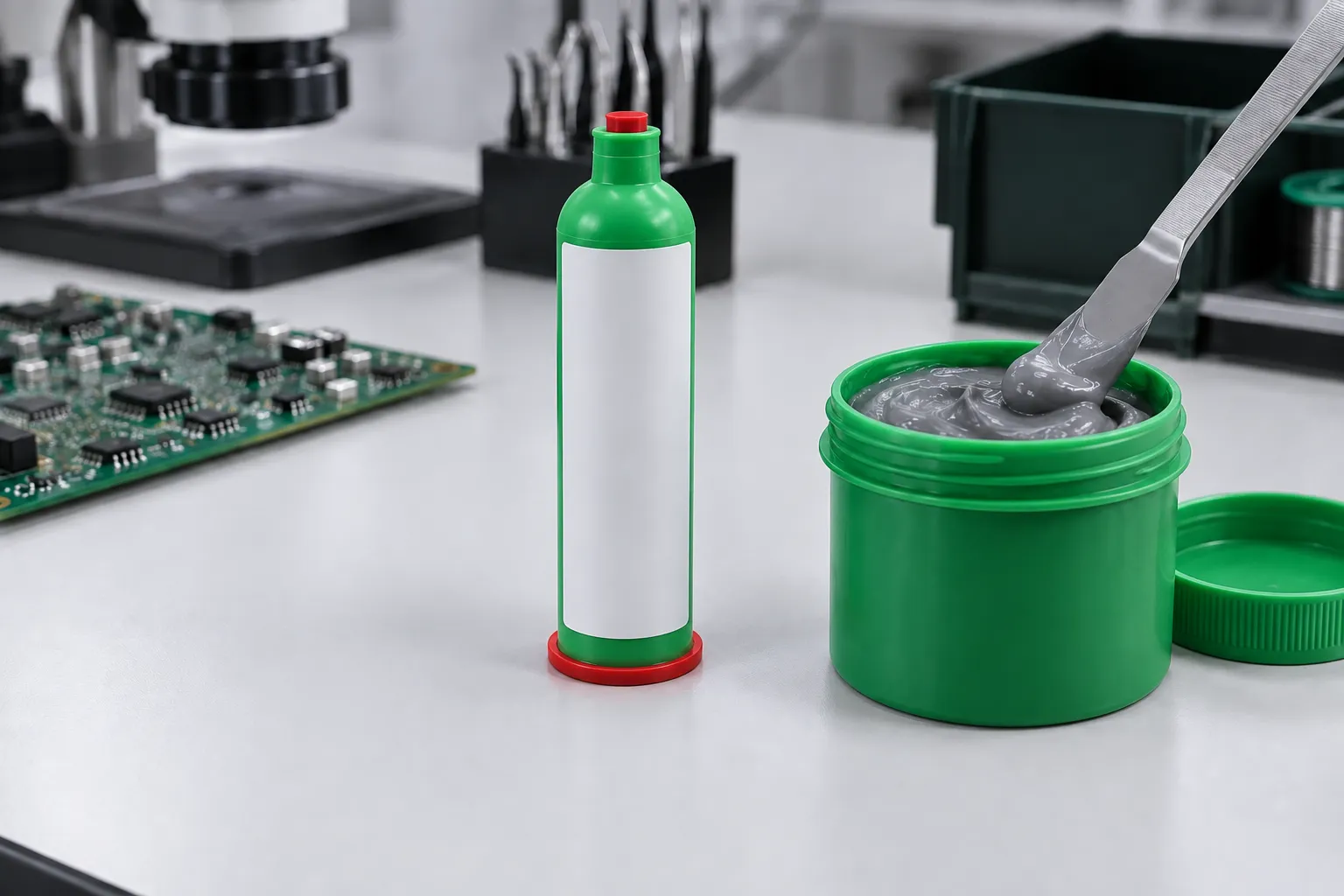
AIM Solder H10, NC257-2 and M8 no-clean pastes in SAC305 alloy and in the AIM alloys REL22 and REL61, in jars and vertical syringes. For mixed-technology boards, see also selective soldering and flux-cored wires for rework.
Why Choose Our Solder Pastes
Technical advantages and performance for professional SMD applications

Type 3 and Type 4 Powders
Alloy particle size according to IPC J-STD-005
| Type | Sphere diameter | Typical use | Notes |
|---|---|---|---|
| Type 3 | 25–45 µm | Standard components | Pitch ≥ 0.5 mm, standard QFP and BGA |
| Type 4 | 20–38 µm | Fine pitch | Fine pitch, QFN, BTC, small apertures |
The AIM Solder pastes distributed by Dickmann
Dickmann distributes AIM Solder solder pastes in Italy. These are the three main products, with the data declared by the manufacturer.
| Product | Characteristics | Alloys | When to choose it |
|---|---|---|---|
| H10 | No-clean ROL0 (IPC J-STD-004), halogen-free; transfer efficiency above 90 % at an area ratio of 0.50; stencil life over 8 hours | SAC305, REL22, REL61 | Fine pitch and halogen-free specifications |
| NC257-2 | No-clean, clear and low residues, long tack time; reflow in air, nitrogen and vapour phase | SAC305, REL22, REL61 | General production, vapour phase |
| M8 | No-clean with Type 4 powder; reduces voids on QFN and BTC and eliminates head-in-pillow on BGAs; transparent residues | SAC305, REL22, REL61, Sn62Pb36Ag2 | High-density components |
REL22 is the high-reliability AIM alloy for under-the-hood environments and severe thermal cycling; REL61 is AIM's low-silver alternative to SAC305. Full data are in the AIM technical data sheets.
Paste in the SMT process
In SMT assembly the paste is printed through the stencil onto the pads, checked by SPI inspection, receives the components from the pick and place machine and then melts in the reflow oven; AOI inspection checks the joints. The paste affects almost every step.
- Stencil life: how long the paste remains printable on the stencil without losing quality.
- Tack time: how long the paste holds the components before reflow.
- Slump: how much the deposit spreads after printing; high slump promotes bridging.
- Reflow profile: preheat, peak and time above liquidus must be adapted to the paste, alloy and board.
Storage and use
Solder pastes must be stored in a refrigerator and allowed to reach room temperature, closed, before opening, to avoid condensation. For H10 in T4 powder, AIM specifies 9 months at 0–12 °C or 3 months below 25 °C; for the other products the technical data sheet applies.
- Do not freeze the paste and do not put paste already used on the stencil back into the jar.
- Use older batches first and observe the expiry date shown on the label.
- Stir the paste briefly before use if required by the technical data sheet.
SMT or SMD? Mixed-technology boards
SMT is surface mount technology, SMD is the surface-mounted device. On mixed-technology boards, SMD components are reflow soldered with paste and through-hole (THT) components afterwards, by wave or selective soldering with bars and solid wire. In some cases THT components are also reflow soldered using the pin-in-paste technique.
SMD Paste Application Sectors
Specialised applications for solder pastes
Consumer Electronics
Smartphones, tablets, household appliances. Type 3 and Type 4 pastes for standard and fine-pitch components.
Automotive
Control units, sensors and modules: halogen-free H10 and REL22/REL61 for joints exposed to thermal cycling.
Industrial
Industrial controls, PLCs and automation systems with high-density components.
LED Lighting
LED modules and power boards, where wettability and void reduction matter.
Which paste to choose
The AIM Solder pastes in the Dickmann range
| Application | Recommended Type | Advantages | Notes |
|---|---|---|---|
| Halogen-free specification, fine pitch | H10 | Halogen-free, long stencil life | SAC305, REL22, REL61 |
| General production | NC257-2 | Wide process window, clear residues | Reflow in air, nitrogen and vapour phase |
| High-density QFN, BTC and BGA | M8 | Low voiding, no head-in-pillow | Type 4; also in Sn62Pb36Ag2 |
| Severe thermal cycling | H10, NC257-2 or M8 in REL22 | AIM alloy for under-the-hood and severe thermal cycling | REL61: low-silver alternative to SAC305 |
The paste is chosen according to components, specification (for example halogen-free) and oven. We help you define product, alloy and particle size.
Frequently Asked Questions about Solder Pastes
Answers to the most common questions about SMD solder pastes
Request a quotation for AIM pastes
See also the SAC305 alloy, the gel fluxes for rework and our ISO 9001 quality system.
Telefono
+39 02 6604 7053