Tin-Lead 50/50 Solder Sticks
Sn50Pb50 alloy for sheet-metal work, zinc coffin liners and traditional industrial applications
50/50 Sn50Pb50 alloy solder sticks produced by Dickmann since 1902 for traditional industrial applications. A lead-containing alternative to RoHS lead-free alloys, intended for sheet-metal work, zinc coffin liners and industrial applications outside the scope of EEE. ISO 9001:2015 certified.
Why Choose Dickmann Sn50Pb50 Solder Sticks
The traditional reference alloy for sheet-metal work, art glass and zinc coffin liners
50/50 Solder Stick Technical Specifications
Metallurgical and dimensional data of the Sn50/Pb50 alloy
| Property | Value | Unit | Notes |
|---|---|---|---|
| Nominal composition | Sn 50 / Pb 50 | % | Balanced tin-lead |
| Solidus | 183 | °C | Start of melting |
| Liquidus | 215 | °C | Fully molten |
| Pasty range | 32 | °C | Ideal for shaping |
| Density | 8.9 | g/cm³ | At 20°C |
| Tensile strength | 35-45 | N/mm² | Bulk alloy, literature values |
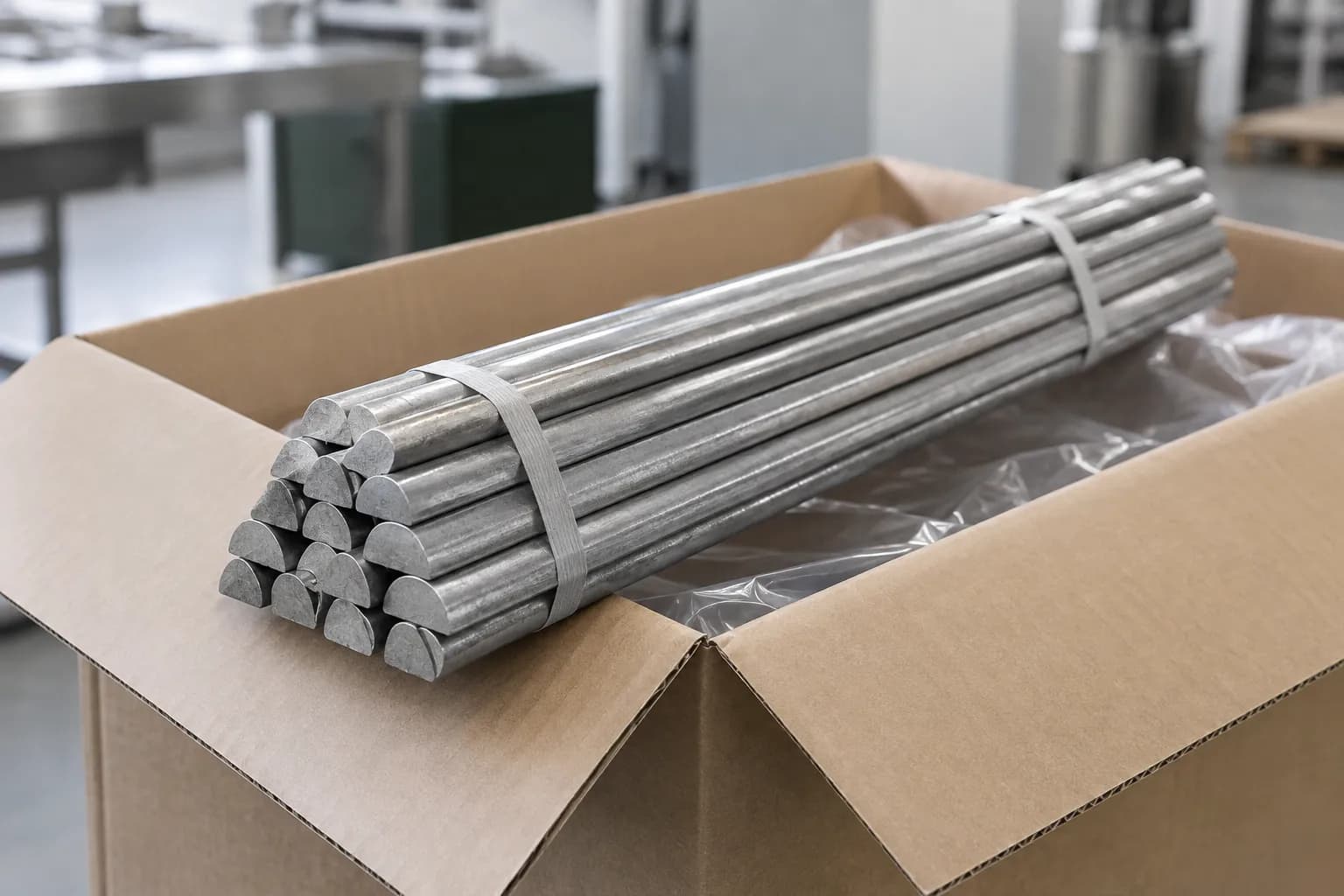
| Stick cross-section | 10 x 6 | mm | Half-moon, '50%' mark |
| Standard length | 410 | mm | 41 cm — industry standard |
| Weight per stick | ~150 | g | Varies with cross-section |
| Standard packaging | 25 | kg | Box, pallets on request |
Application Sectors
Where Sn50Pb50 tin-lead solder sticks are used
Zinc Coffin Liners
Perimeter sealing soldering of zinc coffin liners for industrial and funeral use. The pasty range of 50/50 allows continuous flow and shaping of the bead, for a hermetic seal.
Sheet-Metal Work and Gutters
Soldering of gutters, downpipes, flashings and fittings in zinc, titanium zinc and galvanised sheet. For titanium zinc, manufacturers specify 40/60 or 50/50 alloys with low antimony (Sb < 0.5 %).
Coffins and Funeral Articles
Hermetic closure by soldering of zinc caskets, required by art. 30 of Italian DPR 285/1990. Solder sticks in 25 kg boxes for funeral homes, stonemasons and coffin suppliers.
Leaded Art Glass
Soldering of the joints of lead cames in art glass windows: 50/50 sets quickly and gives strong joints. For the Tiffany technique on copper foil, 60/40 is normally used.
Comparison of Available Sn/Pb Compositions
Which composition to choose depending on the application
| Composition | Solidus / Liquidus | Typical use | Dickmann availability |
|---|---|---|---|
| Sn 33 / Pb 67 | 183 / about 250 °C | Heavy, non-aesthetic work, foundry | On request |
| Sn 35 / Pb 65 | 183 / 245 °C | Economical sheet-metal work, rough fittings | On request |
| Sn 40 / Pb 60 | 183 / 238 °C | Sheet-metal work, titanium zinc | On request |
| Sn 50 / Pb 50 ✅ | 183 / 215 °C | Sheet-metal work, zinc, coffin liners | Immediately in stock |
| Sn 60 / Pb 40 | 183 / 190 °C | Fine soldering, Tiffany glass, refills | Immediately in stock |
| Sn 63 / Pb 37 | 183 / 183 °C (eutectic) | Leaded electronics (legacy) | On request |
The 50/50 alloy is the most requested on the market because its pasty range of about 32 °C allows manual shaping of the bead on zinc and galvanised sheet, which is difficult with eutectic alloys. For titanium zinc, manufacturers specify 40/60 or 50/50 alloys with low antimony (Sb < 0.5 %).
Frequently Asked Questions about 50/50 Solder Sticks
Everything you need to know before ordering
Request a Quote for 50/50 Solder Sticks
Explore the dedicated applications: zinc coffin soldering and lead-acid batteries (dedicated controlled-purity formulation).
Phone
+39 02 6604 7053