Zinc Coffin Soldering
50/50 tin-lead solder sticks for the hermetic soldering of coffin liners and caskets in zinc sheet
Traditional Sn50Pb50 alloy for hermetic perimeter soldering of zinc coffin liners. Our tin-lead 50/50 solder sticks are the traditional alloy of the funeral industry, for the hermetic closure by soldering required by art. 30 of Italian DPR 285/1990. Certification ISO 9001:2015 certification.
Why Choose Dickmann 50/50 for Zinc Coffin Liners
The industry's traditional reference alloy, with certified industrial quality
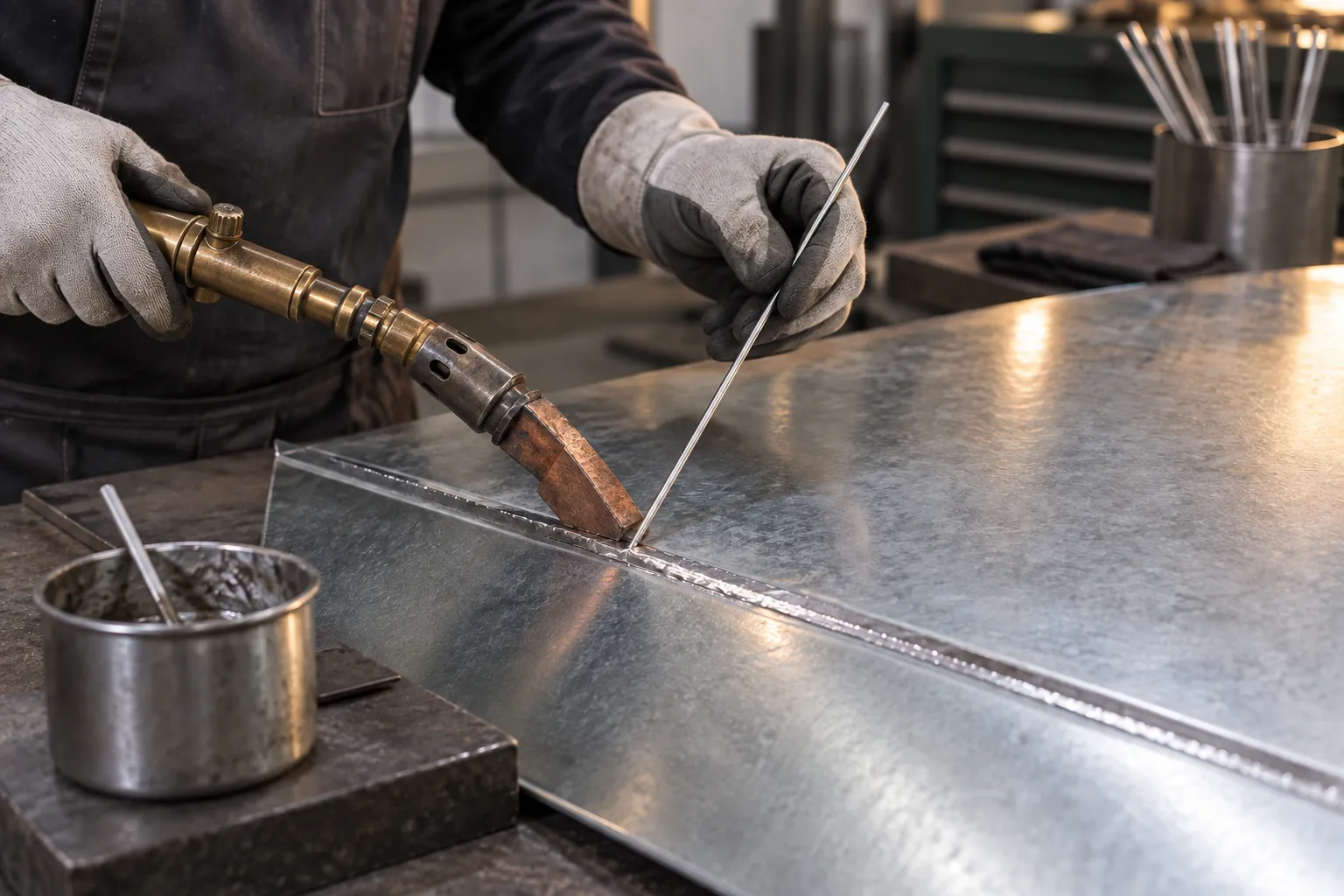
Soldering Process for Zinc Coffin Liners
Standard operating sequence for hermetic perimeter soldering
Sheet preparation and cleaning
Smooth the edges of the liner and the lid to remove oxides and films. Brush with a wire brush to remove residues. The surface must be smooth and free of impurities.
Flux application
Apply a zinc flux based on zinc and ammonium chlorides to the edges to be soldered; muriatic acid (diluted hydrochloric acid) is also traditionally used. The flux removes the zinc oxide and allows the 50/50 alloy to wet the sheet. PPE: gloves, goggles and a half mask with an E-P3 filter for acid vapours.
Positioning the lid
Place the lid on the liner so that the edge matches evenly. Secure with clips or weights to prevent movement during soldering. Check the flatness of the contact surfaces.
Heating with a gas soldering iron
Heat the sheet at the starting point with a gas soldering iron (LPG, propane or butane) or an electric soldering iron to about 250 °C in the joint area, above the liquidus of the alloy (215 °C). Avoid overheating: zinc sheet melts at 419 °C and burns through easily.
Applying the 50/50 solder stick
Place the half-moon solder stick (flat side down) on the hot spot. The alloy begins to melt progressively. Let it flow evenly along the entire perimeter of the lid, maintaining a continuous 3-5 mm bead.
Shaping the bead
In the pasty range (183-215 °C) the alloy remains workable: with the tip of the soldering iron or a spatula, shape the bead to obtain an even finish and a rounded profile. With eutectic alloys (Sn63Pb37) this step is very difficult.
Cooling and inspection
Allow to cool naturally (do not force-cool with water) and remove the flux residues with a damp cloth. Visually inspect the bead for pinholes, cracks or discontinuities. Check the hermetic seal with a pressure test or continuous visual inspection.
Safety: ensure extraction and ventilation of the workplace; PPE: half mask with E-P3 filter against acid and flux vapours, gloves, goggles. At soldering temperatures lead does not give off significant fumes: the risk is mainly from contact and ingestion, so wash your hands and do not eat in the work area. Italian Legislative Decree 81/2008 sets a limit value of 0.15 mg/m³ for lead and a biological limit value of 60 µg/100 ml; health surveillance is mandatory above the thresholds of Annex XLIII-bis, at intervals set by the occupational physician. Directive (EU) 2024/869 provides for lower values, which apply once transposed into national law.
Dickmann 50/50 Alloy: Specifications for Zinc Coffin Liners
Technical data of the Sn50/Pb50 solder stick in the standard configuration for coffin soldering
| Characteristic | Value | Unit | Notes |
|---|---|---|---|
| Composition | Sn 50 / Pb 50 | % | Balanced tin-lead |
| Solidus / Liquidus | 183 / 215 | °C | 32 °C pasty range |
| Density | 8.9 | g/cm³ | At 20°C |
| Stick cross-section | 10 x 6 | mm | Half-moon with '50%' mark |
| Standard length | 410 | mm | Sheet-metal work industry standard |
| Packaging | 25 | kg/box | Pallets on request |
| Standard coffin zinc thickness | 0.66 | mm | Minimum, art. 30 DPR 285/1990 |
| Zinc thickness, derogation | 0.74 | mm | Entombment by derogation (art. 106 DPR 285/1990, Circular 24/1993) |
Application Sectors for Soldering on Zinc
Where 50/50 soldering of zinc coffin liners and metal caskets is used
Funeral Industry
Hermetic closure by soldering of inner zinc caskets, required by art. 30 of Italian DPR 285/1990 for entombment and for the funeral transports covered by the regulation. Continuous perimeter soldering for the tightness of the coffin.
Industrial Packaging
Sealing of galvanised sheet cases and containers for shipping sensitive materials: electronics, precision instruments, museum objects. Leak-tight soldering protects against moisture and water ingress.
Exhumations and Cemetery Articles
Soldering of zinc ossuary boxes and containers for mortal remains. Dedicated supply for funeral homes and stonemasons, with solder sticks in ready-to-use 25 kg boxes.
Special Architectural Sheet-Metal Work
Soldering of complex flashings, zinc gutter fittings, and repair and restoration of zinc roofs. The 50/50 alloy allows fine shaping of the bead on visible joints and curves; for titanium zinc, manufacturers specify 40/60 or 50/50 with low antimony (Sb < 0.5 %).
Hot Soldering vs Cold Sealing
Comparison between the traditional method with 50/50 solder sticks and structural adhesives
| Characteristic | 50/50 soldering (hot) | Cold sealing (adhesive) | Winner |
|---|---|---|---|
| DPR 285/1990 compliance | Yes (flame soldering, art. 30) | Yes (Ministry of Health Circular no. 24 of 24/6/1993) | Both |
| Hermetic seal | Excellent — continuous metallurgical joint | Good — depends on the adhesive | 50/50 ✅ |
| Working time | 20-40 minutes (standard perimeter) | 10-20 minutes + curing time | Adhesive |
| Skill required | Qualified solderer | General labour | Adhesive |
| Operator safety | Flux or acid fumes, contact with lead — PPE mandatory | Solvent vapours — PPE recommended | Adhesive |
| Joint mechanical strength | About 35-45 N/mm² (bulk alloy) | Varies by adhesive | Equivalent |
| Durability | Decades — the metal does not degrade | Variable — some adhesives fail | 50/50 ✅ |
| Tradition and acceptance | Historical standard, widely accepted | Permitted since 1993, less widespread | 50/50 |
Hot soldering with 50/50 solder sticks remains the most widespread and accepted standard for coffins. Cold sealing has been a legitimate alternative since 1993 but has not yet replaced traditional soldering.
Frequently Asked Questions on Zinc Coffin Soldering
Everything you need to know before ordering
Request a Quote for Zinc Coffin Soldering
Discover our tin-lead 50/50 solder sticks hub.
Phone
+39 02 6604 7053