
Alloys for soldering lead-acid battery posts and straps
Controlled-purity Pb-Sn alloys for soldering posts, COS straps and connections of automotive, traction, UPS and stationary batteries
Controlled-purity battery grade Pb-Sn alloys for soldering posts, COS straps and VRLA interconnections. Industrial supply by Dickmann with ISO 9001:2015 certification. See also tinning anodes for ultra-high-purity applications.
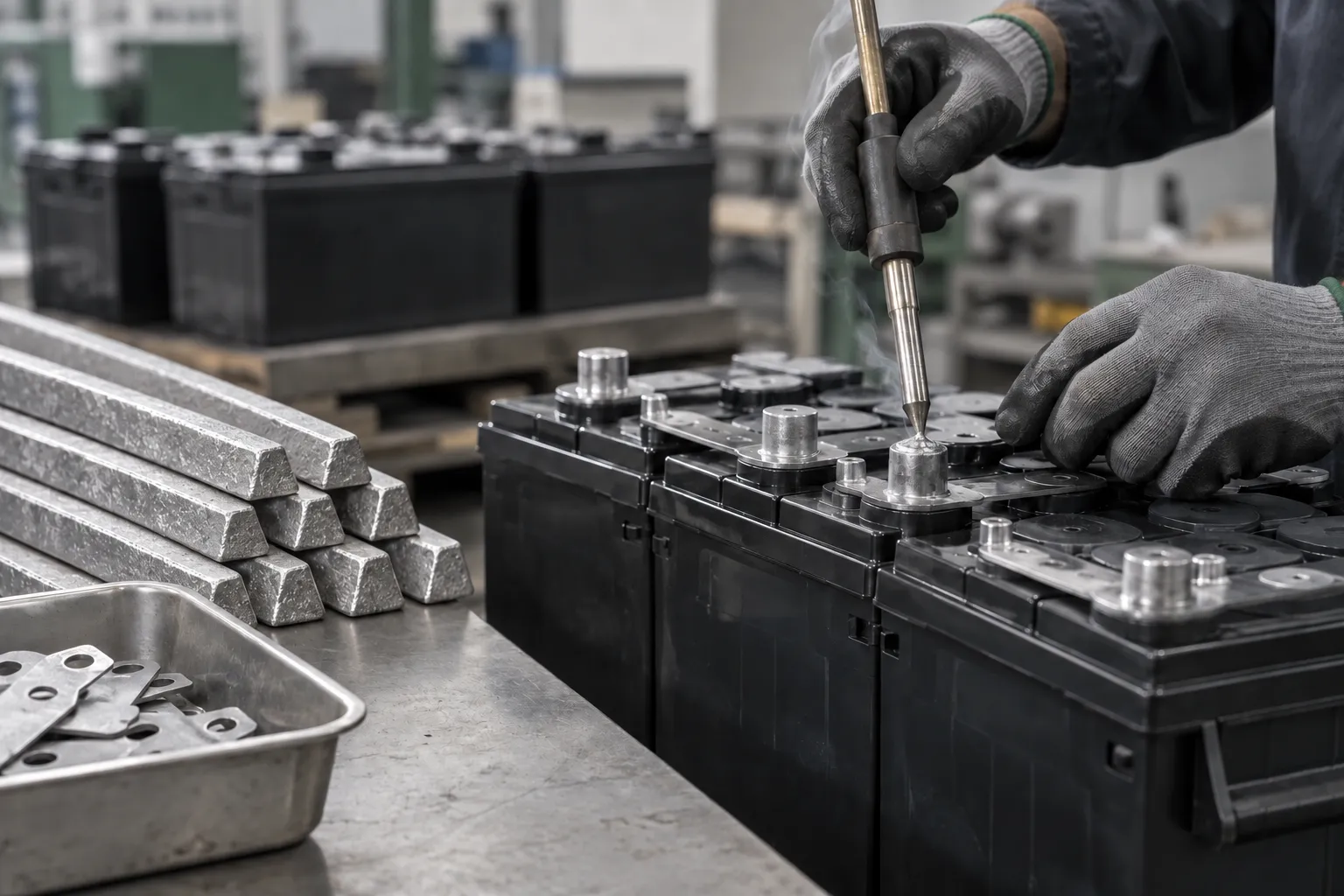
Why Batteries Require Special Alloys
Standard 50/50 is not enough: purity is the critical technical differentiator
Impurity Limits in Lead for Batteries
The real technical differentiator: why trace elements matter in lead-acid batteries
The metallic impurities in the solder alloy do not remain inert: during battery operation they migrate into the sulphuric acid electrolyte. Even a few ppm of some elements can reduce the performance, service life and safety of the battery.
Effects of impurities on batteries
- Accelerated gassing (H₂ and O₂ evolution) → water consumption, risk of explosion in sealed VRLA batteries
- Abnormal self-discharge → the battery discharges even without a load, losing rated capacity
- Reduced service life of the battery
- Accelerated corrosion of Pb-Ca or Pb-Sb positive grids
- Drop in rated capacity and charge/discharge efficiency
| Element | Symbol | Critical effect | Typical specification limit | Criticality |
|---|---|---|---|---|
| Nickel | Ni | Critical gas generator, hydrogen reduction | < 1-5 ppm | 🔴 Extreme |
| Tellurium | Te | Severe gassing | < 1-5 ppm | 🔴 Extreme |
| Manganese | Mn | Catalyst of electrolyte decomposition | < 1 ppm | 🔴 Extreme |
| Cobalt | Co | Abnormal self-discharge | < 5 ppm | 🟠 High |
| Iron | Fe | 10 ppm already harmful to negative active materials | < 5-10 ppm | 🟠 High |
| Chromium | Cr | Gassing | < 5 ppm | 🟠 High |
| Zinc | Zn | Not very critical for gassing | < 5 ppm | 🟢 Low |
| Cadmium | Cd | Not very critical for gassing; restricted by EU rules | < 5 ppm | 🟡 Controlled |
| Antimony | Sb | Gassing if present as an impurity; intentional additive in Pb-Sb alloys | < 30 ppm as an impurity | 🟡 Controlled |
| Selenium | Se | Gassing (but used intentionally at 200-300 ppm in some alloys) | Controlled | 🟡 Controlled |
| Arsenic | As | Gassing (intentional additive at 0.10-0.35% for hardness) | Controlled | 🟡 Controlled |
| Copper | Cu | Abnormal self-discharge | < 50-100 ppm | 🟡 Medium |
| Bismuth | Bi | Non-gassing, tolerated | < 500 ppm (0.05%) | 🟢 Low |
| Silver | Ag | Non-gassing, tolerated | < 50 ppm | 🟢 Low |
VRLA Golden Rule
In sealed VRLA batteries the specification limits are the strictest: for the most critical elements (Ni, Te, Mn) they go down to 1 ppm, for the others they remain in the order of a few ppm, as in the table. Flooded batteries tolerate slightly higher limits. The values to be met are those of the battery manufacturer's specification.
Purity Standards for the Starting Lead
ASTM B29 — Refined Lead
99.94-99.97% Pb min
American standard for refined lead: the Pure Lead grade requires 99.94% Pb, Refined Pure Lead 99.97% (Bi ≤ 0.025%); the Low Bismuth Low Silver grade limits Bi to 0.0015% and Ag to 0.0010%.
BS EN 12659 — Refined Pure Lead
99.94-99.99% Pb
European standard with grades from PB940R (99.94%) to PB990R (99.99%); the purer grades are normally used for batteries. Dickmann supplies lead complying with this specification for battery applications.
Battery Grade Premium
99.985% Pb min
Stricter specification required by premium VRLA manufacturers (corresponds to grade PB985R of BS EN 12659). Available on request with a spectrometric analysis certificate.
Soft Lead / Refined Pure Lead
99.97% Pb
Common trade name in the industry. It refers to refined lead without hardening elements (antimony, calcium), for battery use, with controlled gas-generating impurities.
Specific Compositions by Application
Batteries use different alloys depending on the function of the component
| Application | Typical composition | Standard/patent reference | Notes |
|---|---|---|---|
| Automotive posts/terminals | Pb-Sb 2.75-3.25% / As 0.18-0.28% / Sn 0.20-0.35% / Cu 0-100 ppm | Patent US6300007B1 (reduced copper compared with the conventional alloy at 400-600 ppm) | Torch soldering, high mechanical strength |
| Automotive COS (Cast-On-Strap) straps | Pb-Sb 3.0-3.5% / Sn 0.2-0.4% / As 0.1-0.2% / Se 150-250 ppm | Battery industry standard | Automatic COS line, internal cell connection |
| Sealed VRLA interconnections | High-purity Pb-Sn, gas-generating impurities within VRLA specification | Premium VRLA specification | Maximum stringency - sealed batteries sensitive to gassing |
| Post repair (maintenance) | Pb-Sb 4-6% (high antimony, classic) | Historical repair standard | Oxy-acetylene torch, high hardness |
| Oxide for active material | Pure Pb 99.97-99.99% (no additives) | BS EN 12659 / ASTM B29 | Not for soldering: raw material for the oxide |
| Pb-Ca grids (maintenance-free) | Pb-Ca 0.07-0.09% / Sn 0.3-1.5% | Modern VRLA technology | Low-Sb alternative for reduced self-discharge |
⚠️ The 50/50 alloys (Sn 50% / Pb 50%) for sheet-metal work, coffin liners and coffins, including our solder sticks, are NOT suitable for battery soldering: the composition is too rich in tin and they are not formulated for the required impurity limits. For battery production and repair, use only battery grade alloys formulated on the basis of the ASTM B29 / BS EN 12659 standards.
Battery Grade Customer Sectors
Who our controlled-purity alloys are intended for
Automotive Battery Manufacturers
Manufacturers of SLI (Starting-Lighting-Ignition) batteries for cars, trucks and buses. Recurring supply of Pb-Sb 3% alloy for post soldering and COS alloys for automatic lines. Consistent lots for stable QC.
Industrial Traction (Forklifts, AGVs)
Traction batteries for forklifts, AGVs (Automated Guided Vehicles), golf carts and earth-moving machinery. High-capacity batteries with deep cycles. Post repair with high-antimony alloys.
UPS and Stationary Telecom
Maintenance providers for data centre UPS, -48V stationary batteries for telecom exchanges, off-grid solar storage systems. Strict VRLA specifications for gas-generating impurities.
Reconditioning and Rebuilding
Companies specialised in reconditioning industrial batteries, rebuilding spent traction batteries, repairing posts and cells. We supply alloys in 25 kg boxes and pallets for specialised workshops.
European Regulatory Framework
Regulatory compliance for Pb-Sn alloys intended for lead-acid batteries
RoHS 2011/65/EU — Batteries out of scope
Batteries are outside the directive
Batteries fall outside the scope of the RoHS Directive 2011/65/EU (recital 14): they are governed by Regulation (EU) 2023/1542. The use of lead alloys for the production and repair of batteries is therefore permitted.
Reg. (EU) 2023/1542 — Batteries
EU Batteries Regulation (repealed 2006/66/EC as of 18 August 2025)
It restricts mercury, cadmium and, in portable batteries, lead, and sets obligations on labelling, collection and recycling. Conformity of the battery is the manufacturer's responsibility: for every alloy lot we supply the composition data.
REACH Reg. (EC) 1907/2006
Lead as SVHC, not subject to authorisation
Lead has been on the SVHC Candidate List since 2018 but is not in Annex XIV: its use does not require authorisation. The information obligations (Art. 33) and the restrictions of Annex XVII apply. The REACH-compliant safety data sheet (SDS) is available on request.
Legislative Decree 81/2008 — Operator safety
Protection of workers exposed to lead
It protects workers exposed to lead: local exhaust ventilation, PPE, health surveillance with blood lead testing. It sets a limit value of 0.15 mg/m³ for lead and a biological limit value of 60 µg/100 ml; surveillance is mandatory above the thresholds of Annex XLIII-bis, at intervals set by the occupational physician. Directive (EU) 2024/869 provides for lower values, which apply once transposed into national law.
Battery Grade Alloy vs Generic 50/50
Why sheet-metal work alloy must NOT be used on battery posts
| Characteristic | Dickmann Battery Grade Alloy | Generic uncontrolled 50/50 | Consequence |
|---|---|---|---|
| Composition | Pb-Sb 3% / Sn 0.3% / As 0.2% (formulated) | Sn 50% / Pb 50% (balanced) | Opposite compositions |
| Nickel impurity (Ni) | Within specification (typically 1-5 ppm) | Not controlled | Severe gassing |
| Tellurium impurity (Te) | Within specification (typically 1-5 ppm) | Not specified | Severe gassing |
| Iron impurity (Fe) | Within specification (typically 5-10 ppm) | Not controlled | Degradation of negative active materials |
| Certificate of analysis per lot | Yes, for every lot | Not always available | Manufacturer QC impossible without it |
| Lot traceability | Complete lot → customer | Typically absent | Difficult audits |
| Expected battery life | Rated design life | Reduced in case of contamination | Early replacements |
| Cost per kg | Premium (purity) | Standard | The saving on the alloy is lost in batteries that last less |
The saving on buying a generic alloy is lost in early replacements: for posts, straps and connections, battery grade alloys with a certificate of analysis are used.
Frequently Asked Questions on Battery Soldering
Technical, regulatory and operational specifications for the battery industry
Request the Chemical Analysis Certificate
For the standard 50/50 alloy (sheet-metal work, coffin liners, coffins) see the tin-lead 50/50 solder sticks hub. For ultra-high-purity applications see tinning anodes.
Phone
+39 02 6604 7053