Lead-free solder alloys: a selection guide
SAC305, SAC0307, SAC405, Sn-Cu and 99SnCuNiGe (SN100C equivalent) in bars, wires and pastes
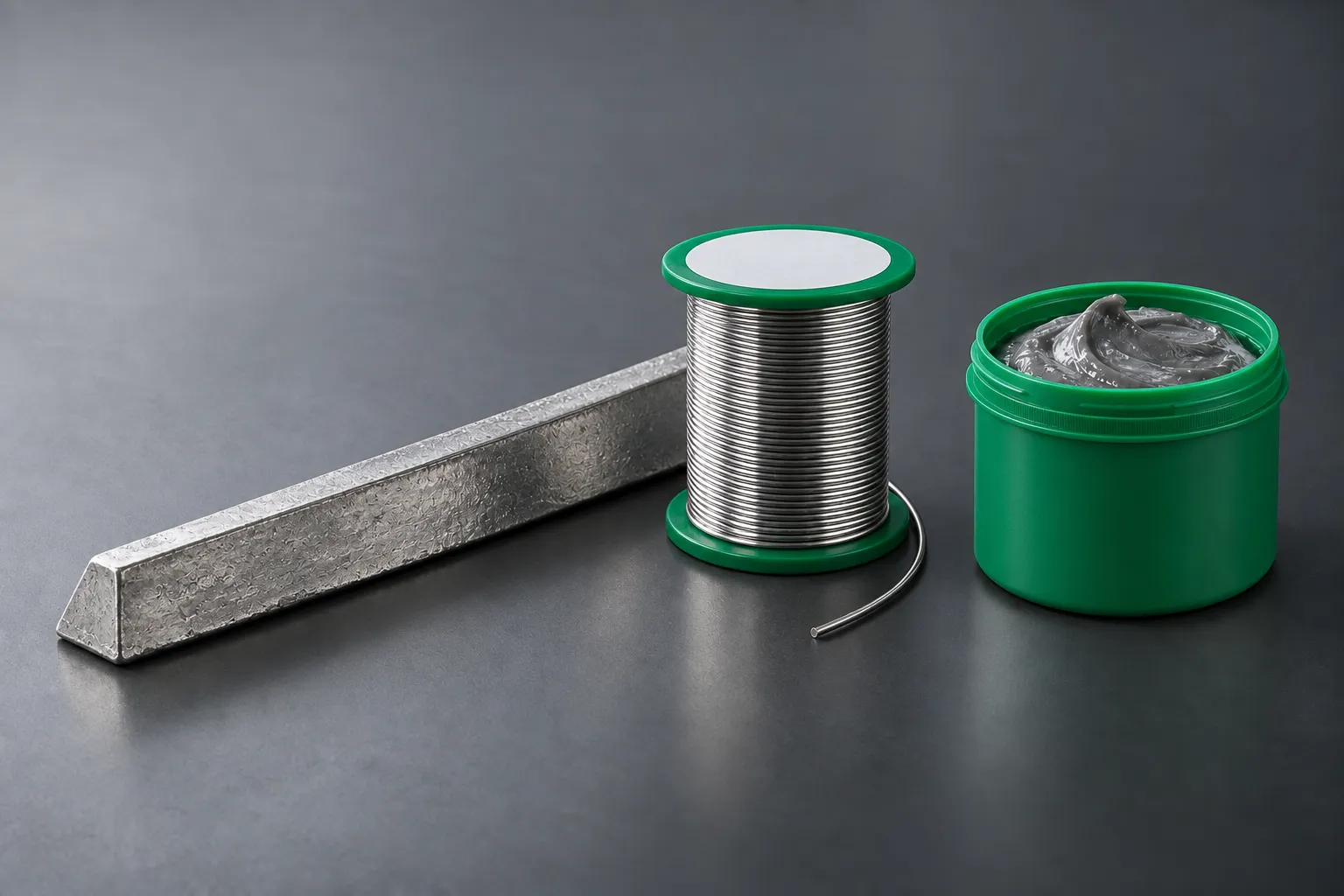
Lead-free alloys are solder alloys without lead, mandatory for electronic equipment subject to the RoHS directive. Dickmann supplies them in bars, wires and pastes: SAC305, low-silver SAC0307, high-silver SAC405, and silver-free Sn99.3Cu0.7 and 99SnCuNiGe (SN100C equivalent). The choice depends on the process and on cost. Our lead-free alloys are essential for consumer electronics, automotive and industrial applications. Discover also our SAC305 alloys and our quality certifications.
Why Choose RoHS Compliant Lead-Free Alloys
Environmental and regulatory advantages of lead-free alloys for sustainable soldering
Lead-free alloys compared
Composition, melting and recommended process
| Alloy | Composition | Melting | Recommended process |
|---|---|---|---|
| SAC305 | Sn96.5/Ag3/Cu0.5 | 217–220 °C | SMT reflow, wave, selective, manual |
| SAC0307 | Sn99/Ag0.3/Cu0.7 | 217–227 °C | Wave, selective, HASL |
| SAC405 | Sn95.5/Ag4/Cu0.5 | 217–219 °C | High-reliability specifications, on request |
| Sn99.3Cu0.7 | Sn99.3/Cu0.7 | 227 °C | Wave, tinning, wiring |
| 99SnCuNiGe (SN100C equiv.) | Sn/Cu0.7/Ni0.05/Ge | 227 °C | Wave, selective, HASL |
| Sn96.5Ag3.5 | Sn96.5/Ag3.5 | 221 °C | Eutectic, bright joints |
Lead-Free Application Sectors
Applications for sustainable, environmentally friendly soldering
Electronics
SMT, THT and mixed boards for industrial and consumer electronics subject to RoHS.
Automotive electronics
Control units, sensors and wiring, with a certificate of analysis for every lot.
PCB fabricators
Lead-free alloys for HASL pots: SAC0307, Sn99.3Cu0.7 and 99SnCuNiGe.
Industry and energy
Industrial controls, automation, inverters and renewable energy.
Lead-free alloys and tin-lead alloys: the differences
What changes in production when switching from lead to lead-free alloys
| Aspect | Lead-free | Tin-lead | Note |
|---|---|---|---|
| Melting temperature | 217–227 °C | 183 °C (Sn63Pb37) | Lead-free alloys require higher process temperatures |
| Wetting | Good, with suitable fluxes | Excellent | Flux and thermal profile must be adapted |
| Joint appearance | Matt (SAC), bright (Sn-Cu-Ni-Ge) | Bright | Different inspection criteria |
| Regulations | Mandatory for RoHS products | In RoHS products only with exemptions | RoHS directive 2011/65/EU |
| Cost | Depends on silver | Generally lower | Silver-free alloys reduce the difference |
In electrical and electronic equipment subject to RoHS, lead is permitted only in exempted uses: for these products the choice is among lead-free alloys, based on process and cost. Lead-containing alloys remain permitted outside the scope of RoHS, for example in vehicles (the ELV Directive, with its own exemptions) and in non-electrical uses.
Frequently Asked Questions about Lead-Free Alloys
Answers to the most common questions about sustainable soldering
Choose the lead-free alloy for your process
SAC305, SAC0307, Sn-Cu and 99SnCuNiGe (SN100C equivalent) · Available in Italy and Europe Discover also our related products and our no-clean fluxes.
Telefono
+39 02 6604 7053