
Soft Solder Alloys for Copper Pipes: Drinking Water and Heating
Lead-free Sn97Cu3 and Sn97Ag3 alloys for capillary soldering of copper pipes and fittings
Lead-free alloys for soft soldering of copper pipes: Sn97Cu3 tin-copper alloy and Sn97Ag3, designated in EN ISO 9453, to be used with a suitable flux. For gas systems UNI 7129 does not allow soft soldering: brazing or certified press fittings are required. Dickmann does not supply brazing alloys.
Why Choose Our Alloys for Building Services
Technical advantages and reliability for professional installations
Building Services Alloy Technical Specifications
Alloys for soft soldering of copper pipes according to EN ISO 9453
| Type | Composition | Melting Point | Application |
|---|---|---|---|
| Sn97Cu3 | Sn97/Cu3 | 227–310 °C | EN ISO 9453 no. 402 · domestic water and heating |
| Sn97Ag3 | Sn97/Ag3 | 221–224 °C | Narrow melting range · more fluid joints |
Capillary soldering of copper pipes: the procedure
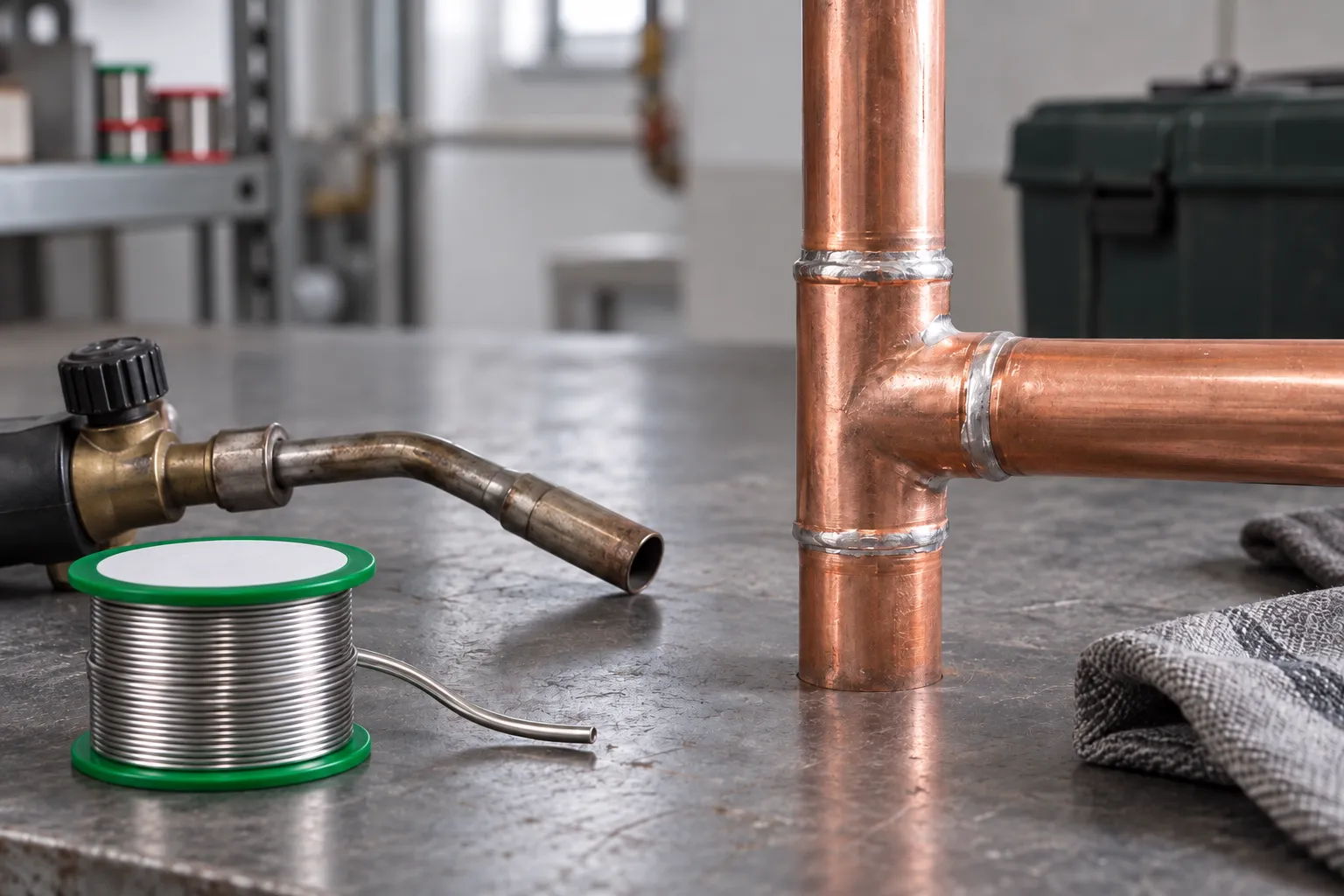
Soft soldering of copper pipes works by capillary action: the molten alloy enters the gap between pipe and fitting. The quality of the joint depends above all on the preparation.
- Cut the pipe square and remove the internal and external burr.
- Clean the outside of the pipe and the inside of the fitting to bright metal.
- Apply a thin film of plumbing flux to pipe and fitting.
- Insert the pipe fully into the fitting and heat the fitting evenly.
- Bring the wire to the edge of the joint: the alloy must melt on contact with the hot copper, not with the flame.
- Let it cool without moving the joint and remove the flux residues.
Alloys and limits of use
For domestic water and heating, lead-free alloys designated in EN ISO 9453 are used: Sn97Cu3 and Sn97Ag3, available as solid wire from 0.5 to 4 mm on spools from 0.25 to 4 kg. For gas pipes and refrigeration circuits soft soldering is not permitted: brazing is required, which Dickmann does not supply, or, for gas, certified press fittings.
Building Services Application Sectors
Professional applications for every type of system
Sanitary plumbing
Copper pipes and fittings for hot and cold domestic water, with lead-free alloys.
Heating
Heating systems, manifolds, radiators and radiant panels with copper pipes.
Fittings and valves
Capillary soldering of copper and brass fittings on water and heating pipework.
Maintenance and repairs
Work on existing systems: replacement of sections of copper pipe and fittings.
Sn97Cu3 or Sn97Ag3: which one to choose?
The two lead-free alloys for soft soldering of copper pipes
| Characteristic | Sn97Cu3 | Sn97Ag3 | Notes |
|---|---|---|---|
| Melting range | 227–310 °C | 221–224 °C | Sn97Ag3 becomes liquid more quickly |
| Workability | Good | Very good | Sn97Ag3 flows better in capillary joints |
| Cost | Lower | Higher | Silver increases the price of the alloy |
| Typical use | Domestic water, heating | Joints requiring more strength | Both lead-free |
For domestic water and heating, soft soldering with Sn97Cu3 or Sn97Ag3 is used. For gas systems and refrigeration circuits soft soldering is not permitted: brazing is required, or, for gas, certified press fittings. Dickmann does not supply brazing alloys.
Frequently Asked Questions about Building Services Soldering
Answers to the most common questions about alloys for pipework systems
Request Advice for Your System
Compare the tin-copper alloys, choose the flux and find out about our ISO 9001 quality system. Request a quotation for formats and quantities.
Telefono
+39 02 6604 7053